
DataFramer vs Raw Claude: Long-Form Data Generation
Same LLM, dramatically different results. DataFramer vs raw Claude on 50K-token document generation.

Alex Lyzhov
Summary
We generated 50K-token documents using the same frontier LLM and got dramatically different results. In the baseline, outputs collapsed into short, repetitive “summary essays”. With DataFramer’s scaffold, we consistently got full-length, style-faithful documents across 4 long-text datasets.
What surprised us most (real examples):
- Real Estate: baseline repeated “Zoning” 8 times; DataFramer produced 15 distinct topics from 5 inputs.
- Gutenberg: baseline reused the same plot loop; DataFramer generated genuinely varied stories with strong prose.
- Wiki Medical: baseline got shorter and added unwanted Markdown; DataFramer stayed long and encyclopedic.
Read on for:
- The exact evaluation setup (blind, Gemini 3 Pro)
- The three failure modes (mode collapse, style drift, length shrinkage) and how scaffolding prevents them
- Full outputs + scripts for reproducing our results
Introduction
Teams running long-form AI generation in production see the same failures in their traces: outputs that repeat the same topics, drift from the expected style, or come back much shorter than required. Getting eval coverage for those failures is where things get complicated.
Long-form synthetic text generation (10K-100K tokens per sample) is hard because the tool you’d use to generate eval data has the same failure modes you’re trying to test. Raw LLMs commit to tokens without lookahead, can’t revise earlier sections, and drift or repeat as context grows. You need outlining, state tracking, iterative revision, and verification loops to produce eval data that actually covers mode collapse, style drift, and length shrinkage.
What is DataFramer?
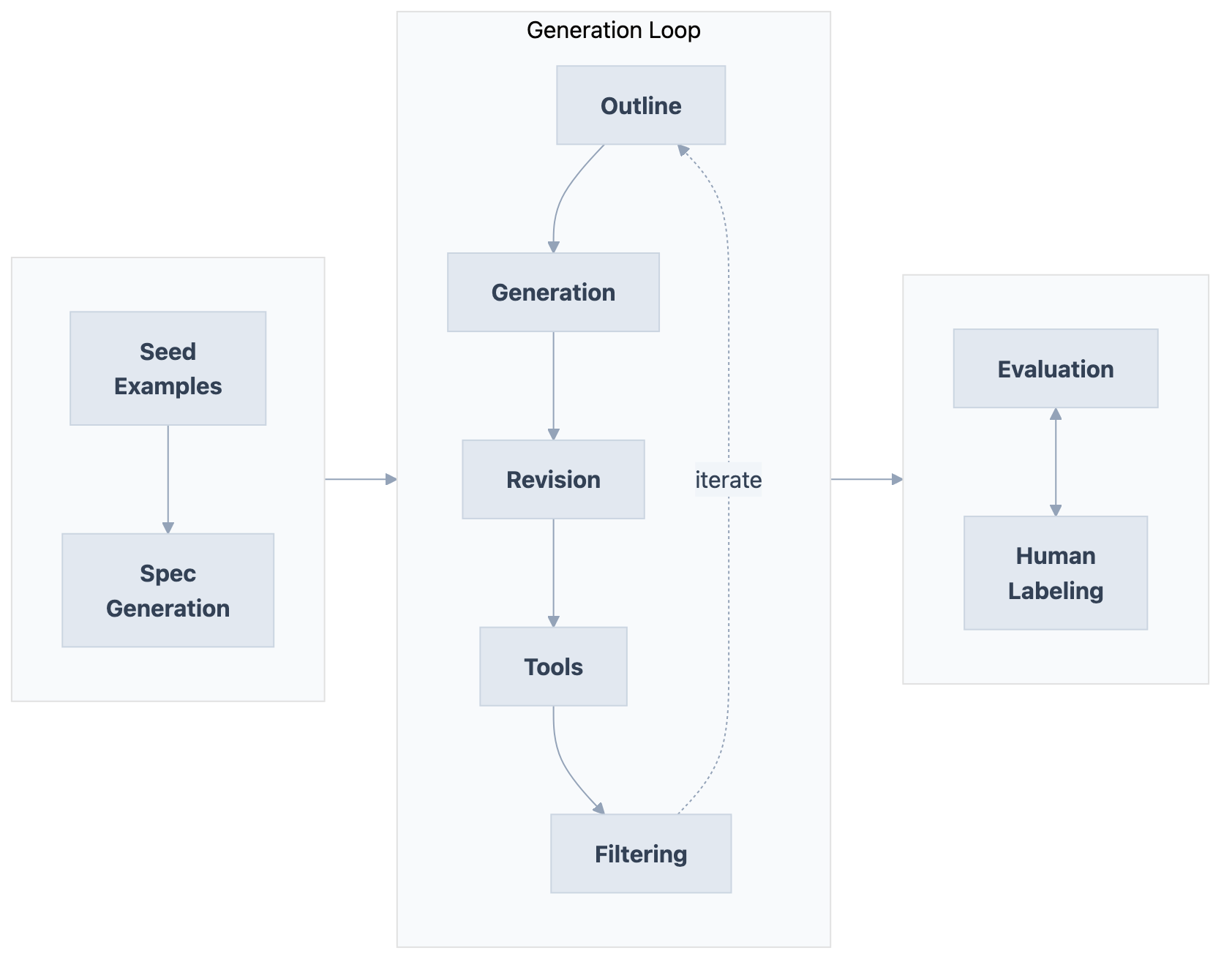
DataFramer starts from production traces: failures and interesting AI outputs you’ve found through review. It analyzes them to build a spec that captures the properties and variation in your data, then generates labeled eval samples from that spec using outlining, evaluation loops, and revision cycles. For more details, see our documentation.
Experiment Setup
Datasets
We manually collected 4 datasets with long texts as seeds for style and formatting conditioning:
| Dataset | Source | Number of Samples | Sample Length | Description |
|---|---|---|---|---|
| Wikisource | Download | 2 texts | 35k-50k tokens | ”Results and Prospects” (Trotsky) + “The Time Machine” (H.G. Wells) |
| Gutenberg | Download | 2 texts | 45k-50k tokens | ”The Call of the Wild” (Jack London) + “The Time Machine” (H.G. Wells) |
| Wiki Medical | Download | 2 articles | 25k-30k tokens | ”Healthcare in Canada” + “History of Medicine” |
| Wiki Real Estate | Download | 5 articles | 5k-15k tokens | NIMBY, Real Estate Economics, Intellectual Property, Property Management, REITs |
Generation Protocol
We generated up to 15 samples for each dataset. Generation followed the standard flow and was almost completely hands-off:
- Load seed data
- Generate a spec using Claude Sonnet 4.5, a blueprint that captures the structure, patterns, and requirements of your data
- Make minimal spec edits (see below)
- Generate samples
The spec edits were trivial: we only made changes in 2 places across all 4 datasets. See the before/after specs:
| Dataset | Generated Spec | Edited Spec | Change |
|---|---|---|---|
| Wiki Medical | spec | (same) | No changes |
| Wikisource | before | after | Removed last sentence about length (platform determines length automatically) |
| Wiki Real Estate | spec | (same) | No changes |
| Gutenberg | before | after | Changed “from” to “resembling those from” (we want new fiction, not reproductions) |
There was no cherrypicking: we did not select datasets where DataFramer performs well, nor make algorithm changes for these datasets. All seed datasets, generation specs, and scripts are included for reproducibility.
Baseline
As of January 2026, to the best of our knowledge, we have not identified a commercially available system that provides comparable general-purpose generation of diverse long-form texts. Therefore, we compare against a raw frontier LLM baseline: Claude Sonnet 4.5 with low reasoning mode (1024 tokens of reasoning). DataFramer uses the same model for all its internal roles (outlining, generation, filtering, revision). The only difference between the two methods is our agentic framework.
Evaluation Methodology
We designed the LLM evaluation framework and eval harness to be maximally fair:
- Systems anonymized as “System 1” (DataFramer) and “System 2” (baseline Claude Sonnet 4.5), same number of samples for each
- We used an LLM as a judge approach with an independent evaluator from a different model family: Gemini 3 Pro Preview with high reasoning mode
- Evaluator received all samples from both systems in one context window and compared them across 7 dimensions: Diversity, Style Distribution Matching, Length, Quality, Artifacts, Validity, and Overall Assessment
Results
At a Glance
| Dataset | DataFramer | Baseline (Sonnet 4.5) |
|---|---|---|
| Wikisource | Full novellas with compelling plots, authentic period voices | Only produced dry essays, ignored fiction entirely |
| Gutenberg | Superb prose quality, massive creativity | Plot loop - same expedition story repeated |
| Wiki Real Estate | 15 unique topics from 5 inputs, perfect style match | 8x “Zoning”, 4x “Land Value Tax” |
| Wiki Medical | Long-context coherence, encyclopedic depth | Too short, added unwanted Markdown formatting |
The same model, the same seeds. The only difference is DataFramer’s agentic scaffold.
Deep Dive: Wikisource
| Criterion | DataFramer | Sonnet 4.5 Baseline |
|---|---|---|
| Diversity | Exceptional - political treatises, epistolary novels, sci-fi, utopias. Creatively merges both inputs. | Very low - nearly all dry expository essays. No fiction, no dialogue. Repetitive titles. |
| Style Distribution | Matches both input styles. Reproduces Wikisource formatting (nav arrows, metadata). Authentic period voices. | Fails - homogenizes everything into generic “academic” voice. |
| Length | Massive long-form content - full novellas with Preface to Epilogue structure. | Short-medium essays, summary-based, lacking depth. |
| Quality | Extraordinary - compelling plots, character arcs, authentic world-building. | Mediocre - reads like undergraduate summaries. |
| Artifacts | Intentionally reproduces Wikisource artifacts (nav links, page numbers). | Strips all formatting. |
| Validity | High - historically grounded, internally consistent. | Moderate - logically sound but platitudinous. |
Winner: DataFramer (vastly superior)
The other three datasets showed consistent patterns: DataFramer maintained diversity and style fidelity while the baseline collapsed into repetitive outputs (Gutenberg: same plot structure repeated; Wiki Real Estate: 80% duplicate topics) and introduced unwanted formatting changes.
Full Evaluation Details
Evaluation summaries and full reports:
- Wikisource: Summary | Full
- Gutenberg: Summary | Full
- Wiki Real Estate: Summary | Full
- Wiki Medical: Summary | Full
All generated outputs (both DataFramer and baseline) are available for download:
- Wikisource: Download outputs
- Gutenberg: Download outputs
- Wiki Real Estate: Download outputs
- Wiki Medical: Download outputs
All data (seeds, DataFramer outputs, and baseline outputs) is also available on HuggingFace.
DataFramer Avoids Typical Synthetic Data Failure Modes
The blind evaluation revealed three distinct failure modes in the baseline that DataFramer successfully avoids:
Failure Mode 1: Mode Collapse
The baseline repeatedly generates the same topics or formulaic plot structures. In Wiki Real Estate, “Zoning” appeared 8 times and “Land Value Tax” 4 times out of 15 samples. In Gutenberg, every story followed the same arc: ship, island, ruins, beings, escape. In Wiki Medical, duplicate “Medical Education” articles appeared.
DataFramer avoids this through diversity injections during the outlining phase, ensuring each sample covers different ground within the topic space defined by the seeds.
Failure Mode 2: Style Drift
The baseline introduces formatting and structural elements not present in the seed data: adding Markdown headers when inputs used plain text, converting dense encyclopedic prose into bullet-point lists, and stripping source-specific formatting artifacts like Wikisource navigation and metadata.
DataFramer avoids this through iterative evaluation and editing loops that keep the generated style tightly matched to the original distribution, continuously comparing output characteristics against seed characteristics.
Failure Mode 3: Length Shrinkage
The baseline generates summaries instead of full documents. Wikisource seeds were 35k-50k tokens; baseline outputs were 2k-5k tokens. Dense, chapter-length inputs became brief essays.
DataFramer addresses this by explicitly accounting for target length during outlining and generation, maintaining long-context coherence through structured revision passes.
Discussion
When building eval datasets like this, a few things need monitoring: topic diversity, style consistency with your inputs, and length profiles. Missing any one of them can produce a dataset that tests the wrong thing.
Our evaluation showed that prompting Claude Sonnet 4.5 directly produced repetitive, formulaic outputs across all four datasets. DataFramer’s pipeline, using the same underlying model, produced dramatically better results.
If you’re building similar pipelines, watch for these three failure modes:
- Mode collapse: Count unique topics and structures in your outputs
- Style drift: Compare formatting to your input examples
- Length shrinkage: Check whether outputs are significantly shorter than inputs
Beyond these, raw LLM generation can introduce fabricated values that accumulate silently across large runs. DataFramer’s verification and revision loops catch these before they reach your dataset.
The verification and revision loops that keep this generation clean are the same ones DataFramer runs on your production AI. It surfaces the silent errors in live traces, gets an expert to confirm them, and turns those into calibrated judges and regression sets, so accuracy holds up long after the dataset ships.
For a full breakdown, see Why DataFramer.
100% Valid Text-to-SQL Data With Claude Haiku
From production SQL failure traces to 500 labeled, execution-validated eval samples - using only Claude Haiku.
Alex Lyzhov LLM-as-Judge: Why It's Hard to Get Right
When LLM-as-judge works, when it breaks down, and what it actually takes to build one you can trust.
 Puneet Anand
 How a 3B Model Beat GPT-4o on Hallucinations
A 3B open-source model beat GPT-4o at hallucination detection, built on purpose-built training and eval data.
Alex Lyzhov Get started
Start improving your business outcomes.
Understand how AI is affecting your users and business. Make every AI workflow more accurate, more used, and more valuable.