
Building a Cyber Insurance Evaluation Dataset in 3 Easy Steps with DataFramer.
Scale a few real cyber insurance samples into a full evaluation and training dataset in three steps.

Puneet Anand
Wed Oct 15
The challenge of limited real world data for cyber insurance AI
Imagine you are building an AI assistant to approve or reject insurance applications, say cyber insurance to be particular.
The first roadblock is data.
You need realistic applications with company profiles, security posture, claims history, and quote options. You also need enough variety to measure accuracy and spot the gaps before you deploy.
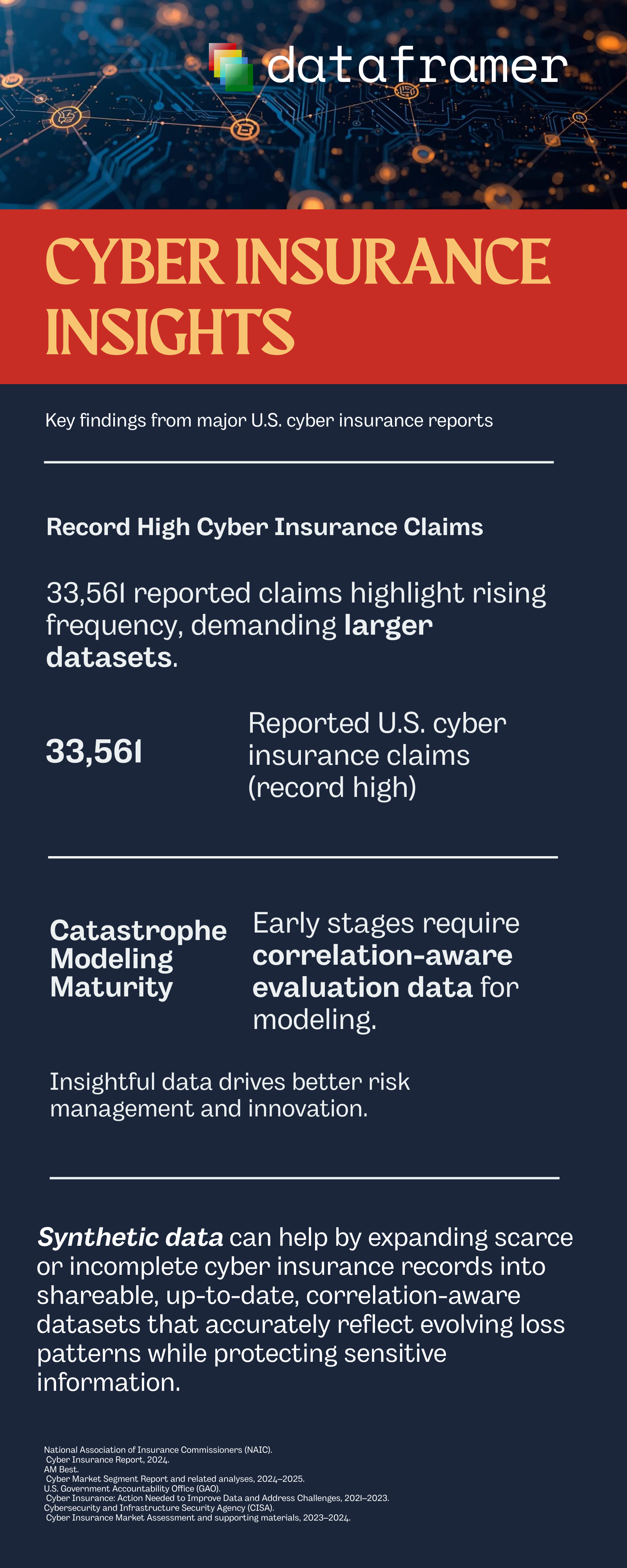
Real submissions are scarce, sensitive, and difficult to share. The scale of this challenge is reflected in industry data: the NAIC reported a record high of 33,561 U.S. cyber insurance claims in 2024, yet carriers representing approximately $8 billion in premium still operate with cyber catastrophe modeling in early stages, according to AM Best’s 2024–2025 market analysis. This modeling immaturity, combined with systemic-risk uncertainty, demands correlation-aware evaluation corpora that go far beyond what limited historical data can provide.
The data scarcity problem runs deeper than volume alone. A 2021–2023 GAO federal review found that cyber loss and event data are “limited, incomplete, or poor-quality,” undermining pricing, benchmarking, and validation of predictive models. This data quality gap prevents the creation of representative training and evaluation datasets that AI systems require. As the CISA Cyber Insurance Market Assessment (2023–2024) notes, “lack of data and limited information sharing constrain the market.” These sharing gaps mean that even when data exists, privacy and competitive concerns prevent carriers from pooling information to build comprehensive datasets.
You cannot ship a critical system without thorough testing, and you cannot test well without a dataset that captures real world complexity. The industry’s data limitations make synthetic datasets not just convenient, but essential—they provide a privacy-safe alternative that can be shared while maintaining structural realism, compensating for thin historical data and supporting repeatable model evaluation.
Synthetic data offers a practical path forward
Synthetic data can expand a small seed dataset into a larger dataset that preserves important structure and patterns while avoiding exposure of real entities.
For cyber insurance use cases, you can start with a few representative application packages that include submission inputs, quote options, risk scores and recommendations, and bindable items checklists.
From there, you can define target distributions for variables such as industry codes, security posture quality, and claims details, and you can encode practical correlations such as how multifactor authentication status tends to vary with overall security posture.
The result is an evaluation and training dataset that looks and behaves like real applications while remaining shareable and privacy safe.
How the three steps work in practice
As shown in the video above, we can follow the same repeatable workflow each time.
Step 1 brings in a few representative multi file application packages as seed data.
Step 2 creates a specification that defines properties, distributions, and conditional relationships.
Step 3 runs generation to produce a larger synthetic set that you can evaluate and iterate until it matches your targets.
Step 1: Seed data brings in the first cyber insurance samples
Prepare a small set of realistic application packages. Each package should be a multi file collection with consistent identifiers. Typical files include submission inputs with company name, business type, NAICS code, headquarters location, security posture and claims details. Include at least one quote options file with policy type and terms, a risk score and recommendations file, and a bindable items checklist. Aim for five files per sample so downstream structure is clear.
Upload the seed folders and verify that the platform detects and indexes the files, keeps cross file consistency for each company, and prepares the dataset for analysis.
Step 2: Specs define distributions and correlations for generation
Create a specification that acts as the blueprint for synthetic generation. The system analyzes the seed set and lists common data properties it detected. For cyber insurance this often includes company profile fields, revenue, industry, prior incidents, requested terms, and security posture quality.
Tune what to include, exclude, and emphasize. Add key properties that matter to underwriting models such as MFA deployment status. Define the target distribution for that property with values like comprehensive, good, limited, and minimal. Configure probability distributions for other properties as needed. Enable correlation handling so conditional relationships are taken into account. For example, you can state that when overall security posture quality is moderate, MFA deployment status should be comprehensive about five percent of the time and good about thirty five percent of the time. You can also allow extrapolation to add related properties not present in the seed set or to extend the value ranges of existing properties.
Save the specification. Advanced users can review and edit the full blueprint in YAML for complete control.
Step 3: Generate synthetic insurance applications
Create a run from the specification. Choose the spec version, pick a model available in your environment such as Claude Haiku from Anthropic, and set the number of samples to generate. Decide whether to enable revisions to automatically recheck outputs against your targets before finalizing. Start the run and monitor progress until the synthetic samples are ready.
The output will contain one folder per synthetic company with the same multi file structure as your seeds. Expect submission inputs, quote options, risk score and recommendations, and bindable items checklists for each generated company.
Reviewing and interacting with the results
Open the evaluation view to verify that generated distributions match your targets for properties like MFA deployment status, security posture quality, industry, and claims indicators. Larger sample sizes tend to converge more closely to the specification. Use the built in chat to ask questions such as how many samples were generated and to list company names in a table. This helps you validate coverage quickly and decide whether to adjust distributions or correlations before the next run.
The impact of this workflow in cyber insurance AI
You gain a sharable, properly structured evaluation dataset that reflects real submission complexity. You can control disease equivalent variables for this domain such as posture quality and MFA status, and you can encode realistic dependencies across fields. You shorten iteration cycles for post training and model selection. You reduce privacy and sharing frictions while keeping enough realism to surface failure modes before deployment.
A future where evaluation data is ready on day one
A small, well chosen seed dataset gives you the structure. The specification gives you control. The run gives you scale. With this three step approach, your cyber insurance models can be tested, compared, and improved with confidence long before you see production traffic.
Synthetic Text-to-SQL Data Generation with 100% SQL Validity Using Claude Haiku
How we generated 500 diverse, 100% valid text-to-SQL samples for LLM evaluation and fine-tuning using only Claude Haiku.
 Alex Lyzhov
 Benchmarking Coding Agents as Math Auditors: A Synthetic Financial Document Dataset
We built a financial benchmark with planted errors to test Claude Code as a math auditor — no manual labeling needed.
Alex Lyzhov Synthesizing Fraud Transaction Scenarios Before Production
Generate labeled fraud scenarios on demand so you can train and benchmark before attacks reach production.
 Gabriel Marrocos
 Get started
Ready to build better AI with better data?
The real bottleneck in AI isn't intelligence. It's the data you can't generate, can't share, or can't trust.