Announcing DataFramer: AI Workflow Intelligence
Three roles, one question: is our AI actually working? DataFramer is the AI Workflow Intelligence Platform built to answer it.

Puneet Anand

Can you answer how AI is affecting your business and users?
If your organization is deploying AI-powered workflows and applications, I can bet a billion tokens that your executives are focused on three things: their adoption, accuracy, and measurable business value without unacceptable risk, even as the AI landscape changes almost daily.
At the same time, there are humble engineers struggling to deploy these presumed-easy AI workflows at scale. A few of the battles I have watched them fight: manually finding silent accuracy failures across thousands of traces, diagnosing where the root cause lies, building reliable evaluation datasets, calibrating LLM judges, and verifying that every change fixes the problem without introducing new regressions.
And in between sit the product leaders, the glue, trying to capture the full user and business journey. They need to understand how AI participates in each workflow step and affects the outcome, bring domain experts into a repeatable review process, and show whether their AI workflows are improving in accuracy, adoption, cycle time, and business value.
Three different roles, and none of them has one place to answer the same question: is our AI actually working, for the business and for the people using it?
Introducing DataFramer
DataFramer is an AI Workflow Intelligence Platform that helps organizations make AI-powered workflows more accurate and manage the business value they deliver.
It connects AI outputs to user and business outcomes, so you can see whether your workflows are becoming more accurate, more widely adopted, faster, and more valuable, through metrics such as funnel completion, cycle time, and business value.
Here is how that works.
A human-guided operating loop
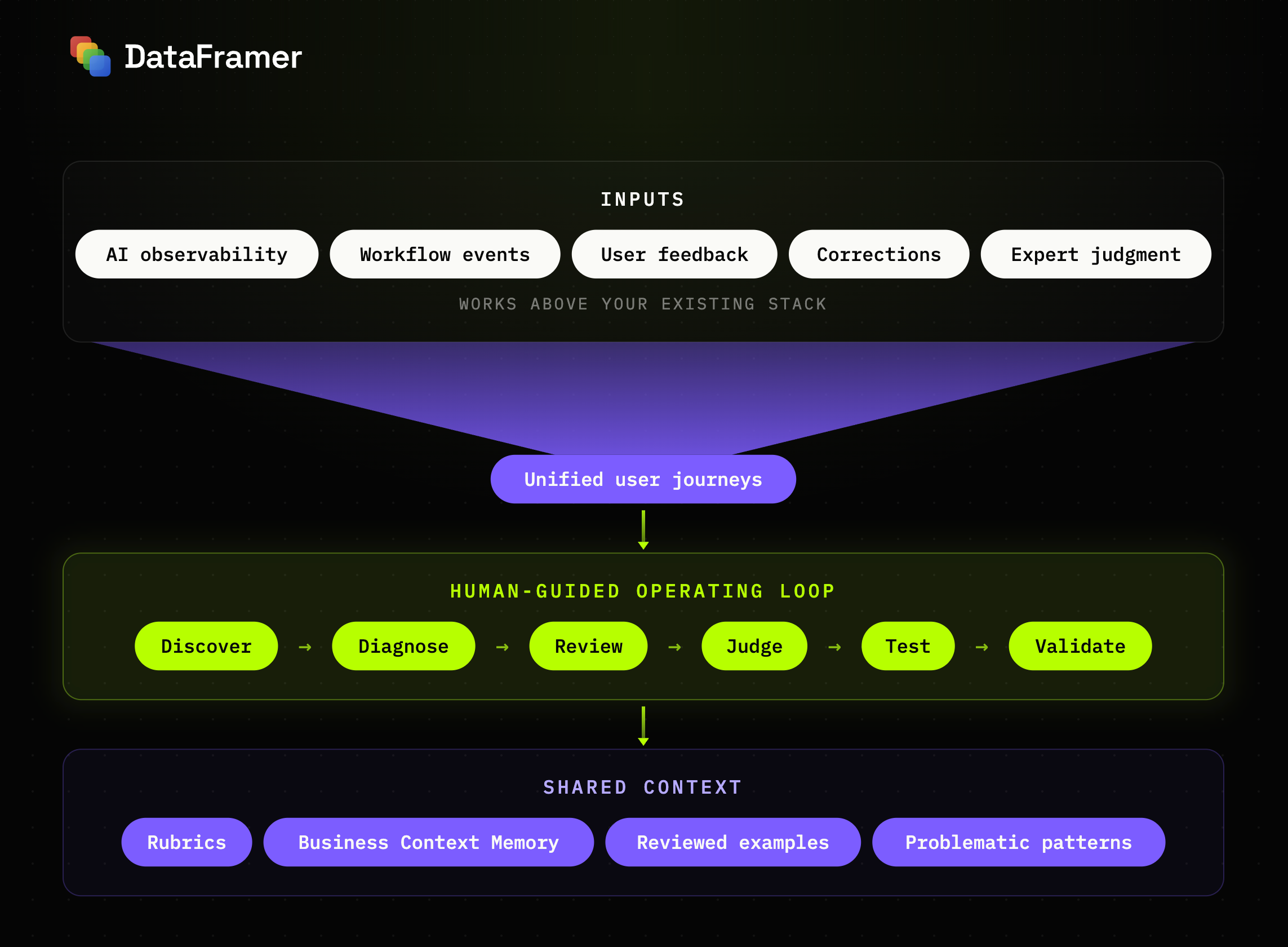
For practitioners, DataFramer brings together AI traces, user behavior, feedback, workflow events, and expert judgment to find meaningful accuracy deviations and route selected traces to the right expert reviewer. An insurance decision might go to a claims specialist, while a clinical summary goes to a physician. DataFramer replaces scattered spreadsheets and one-off messages with a structured, repeatable review process, and then it uses those expert reviews to build and calibrate the automated judges and regression tests that keep checking your AI at scale.
An institutional memory layer for your AI
Because expert judgment is captured instead of lost, each review strengthens DataFramer’s reusable understanding of the organization’s rules, policies, workflows, and standards. Over time, this helps deployed workflows improve more consistently, new workflows reach acceptable accuracy faster, and every future review and evaluation benefit from the context accumulated across earlier work.
And if an accuracy deviation does show up, you can always trace it right down to the exact user actions, AI traces, model behavior, and retrieved documents behind it.
Built to outlast your stack
That accumulated knowledge stays yours, and it protects your AI applications and workflows from the inevitable technical changes in model types (for example, open-weight versus proprietary), model providers, AI tools, storage, and other infrastructure.
DataFramer also runs on top of your AI-powered workflow tech stack, so adopting it does not mean replacing anything.
Why AI Projects Stall Before Production
The demo worked. Here is what actually blocks teams from getting it into production.
Puneet Anand How DataFramer Measures Whether an AI Answer Is Right
In production there's no answer key. Here's how we calibrate LLM judges to your experts' definition of correct, and keep them honest.
Puneet Anand Confidently Wrong AI Is a Business Problem
The dangerous AI mistakes aren't the obvious ones. They're fluent, confident, and wrong, and the business pays before engineering ever knows.
Puneet Anand Get started
Start improving your business outcomes.
Understand how AI is affecting your users and business. Make every AI workflow more accurate, more used, and more valuable.